San Francisco Bay is a fascinating place to paddle, whatever your craft. The interplay of wind, tide and swell produce endlessly variable conditions that can change considerably during any given day.
Aside from the pervasive marine layer (which really is such a blessing saving us from incessant heat) the only downside to summers here are that the big ebb tides are during the night. Now I have been trying to wrap my head around exactly why that is and the best I have come up with is that it is due to the axial tilt of the earth and the relative positions of the earth, sun and moon. That is a rather bland answer but it’s the best I have!

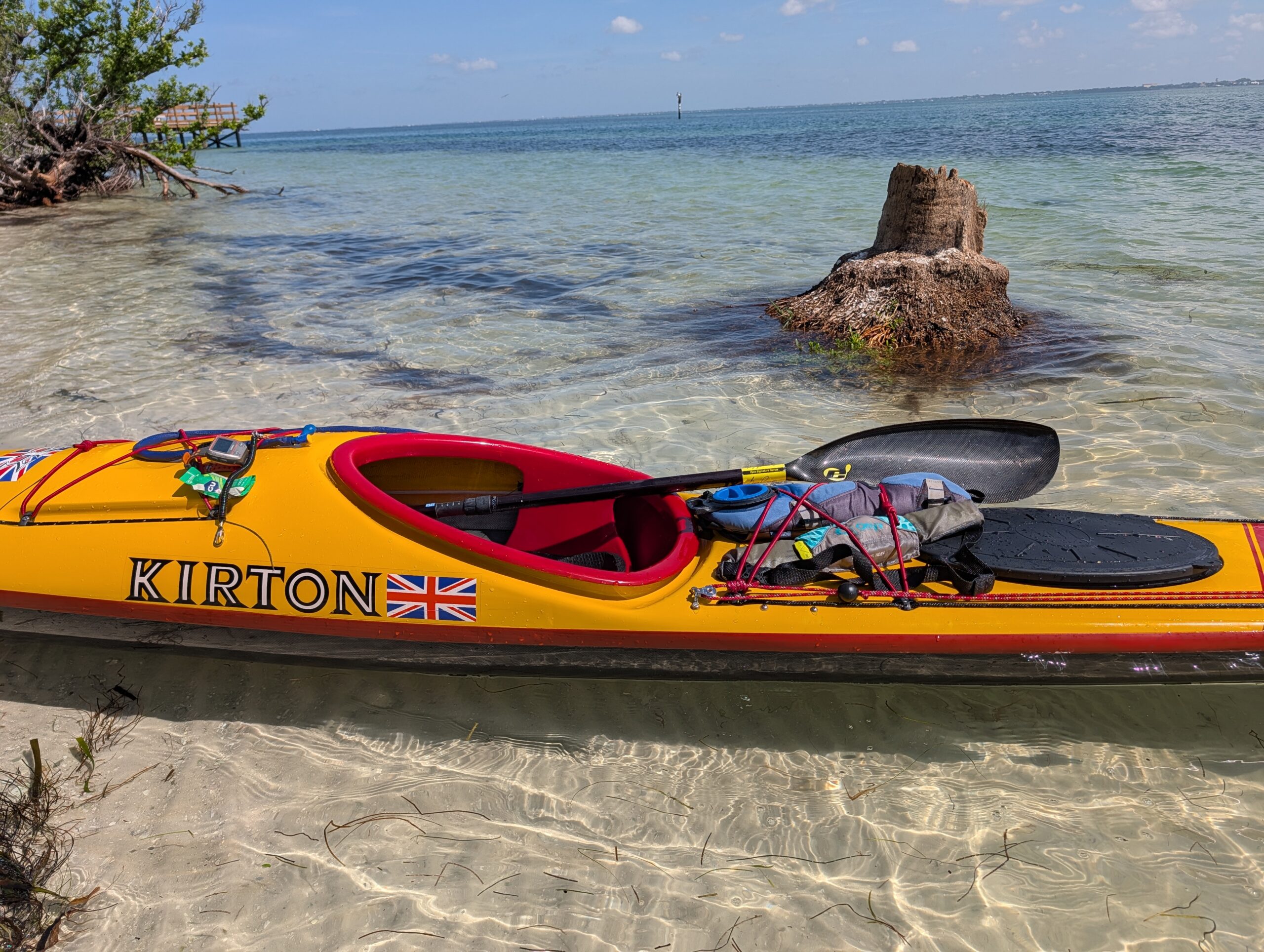
What it means to the paddler trying to find some ebb current to play with during the summer months is that you need to get up REALLY early! In need of some tidal action to test out the used Sterling’s Kayaks Reflection I had recently purchased used from the man himself (thanks Sterling!), I decided on a ‘dawn patrol’, dragging myself out of bed at 4.30am to be on the water for the nearly six knot max ebb at 5.17am (outside the Gate).
The full moon that I imagined sinking into the Pacific Ocean was obscured by fog and the orange incandescent lights of the Golden Gate Bridge created a rather surreal urban glow. The lights of San Francisco formed a ribbon on the southern horizon, the tallest structures decapitated by the marine layer.
There was plenty of light to paddle by as I left Horseshoe Cove on the north side of the Gate and worked my way around to Yellow Bluff, a popular tide race that forms only on the ebb. As I expected, I was rather too late for the best surfing waves at Yellow Bluff; max ebb is quite a bit earlier at Yellow Bluff when compared to outside the Gate and the best waves tend to form early in the ebb anyway and then really only stack up when the wind is against the tide or when a large swell is rolling in through the Gate. There was little or no wind and even less swell so the the ebb current was meeting little resistance and as far as I could tell in the semi-darkness it was just a messy confusion of small waves and eddies.
I bounced down through the race to Lime Point, a protrusion of rock that once had a light station but now just has a fog signal. It is here where the strongest currents in the Bay can be found and there was enough of a sea breeze to set up a few standing waves worthy of the effort to catch them.
By now dawn had arrived but it was still early and Point Diablo and Point Bonita beckoned. With the powerful ebb I knew I would make good time getting out and by working the massive eddies that form downstream of both Point Diablo and Lime Point, I knew I could get back in good time to spend the majority of the day with my family (and watch the World Cup Final!)
Despite the low swell there were still some good roller coaster rides out in the middle of the ebb on my way to Pt Diablo and after a brief pause to play with the rocks I jumped back on the conveyor belt to Pt Bonita. The reefs beneath the lighthouse were as quiet as I have seen them.
The low tide had exposed beds of eel grass that I had not seen before. I meandered through the rocks and under the spectacular arch formed from pillow basalt that is often impassable in big swell. Through the arch a narrow tunnel appears, approximately twenty yards long that cuts through the rock of the Point. The walls of the tunnel are lined with razors; mussels and barnacles that threaten to slice skin or Gore-Tex, but are mixed in with colorful sponges that deserve to be admired as you squeeze past.
Timing the swell correctly you can get a nice push. Get your timing wrong and those razors get awfully close as you bounce off the walls!
And folks, please do as I say and not as I do – paddle with a friend (or two). It’s safer and much more fun. But sometimes you just have to grab it when you can get it…
So back to the tidal conundrum. Why are the strongest ebb currents at night during summer and during the day in winter? Well I put the question out to my learned Facebook friends and the answer I most liked came from Krista Fechner, a member of Bay Area Sea Kayakers. This is how Krista explained it:
Yes, there are variances caused by things like the distance of the earth from the Sun, but the main factor is the tilt of the earth and how any point on earth rotates under the tidal bulge. In the summer, the northern hemisphere is tilted toward the sun. That means that a point like SF moves under the max height of the tidal bulge in mid-day, since during the strongest tides of the month, the sun, earth, and moon will be approximately lined up. It also means that SF is hitting low-low tide close to dawn. Given that max ebb will be a few hours before low-low tide, that puts max ebb into the pre-dawn hours, not when we’re typically out kayaking. Unless you’re Sean Morley. During winter, the tilt of the earth results in just the opposite. SF hits low-low tide near dusk rather than dawn, and this puts max ebb smack in the middle of the afternoon, giving us FUN rides at Yellow Bluff and Raccoon Strait.
Honestly, I couldn’t wrap my head around this until I sketched it out for myself a few years ago. Here’s a quick ‘n’ dirty sketch showing the earth, moon, and sun approximately in line, with the earth rotating under the bulge caused by the gravitational pull of the moon and to a lesser degree, the sun (since the sun is so much further away). You can see that in the summer, we here at latitude 38 end up under a higher point in the bulge (=high high tide) at midday during the summer and at midnight during the winter. When SF is just catching the first rays of dawn in summer, we’re positioned away from the bulge. My sketch does not accurately depict distance, planetary body size, declination of the moon etc., and it does not account for the time lag of the tide level as the earth rotates under the bulge. It just depicts the basics of why the day/night timing of strong ebbs varies summer vs. winter.
Get it? Thanks Krista!
There is also a great online resource that Bill Vonnegut of Neptune’s Rangers brought my attention to. Thanks Bill!
I am all in favor of keeping things simple so don’t get hung up on this stuff but one resource that I could not be without is my trusty Tide Log.
By the way, the summertime flood tides can be fun too, especially around the south tower of the Golden Gate Bridge, but it does put you right out in the middle of the shipping channels AND I have had more than one run-in with the Coastguard and the police because I was within the 25 yard exclusion zone around the bridge support – and the rumor is the police now have drones as well as CCTV to keep any eye on you – so you have been warned!