AN EXPEDITION IN OUR OWN BACKYARD
In September 2010 three California-based paddlers attempted to be the first team to visit all eight of the Channel Islands of California by kayak in one continuous journey. Legendary open ocean pioneer Ed Gillet is believed to have visited seven islands in one trip (missing San Nicholas) and local limit-pusher Duane Strosaker has also visited the same seven (in separate trips) but no-one, perhaps since the time of the Chumash people has visited all eight.
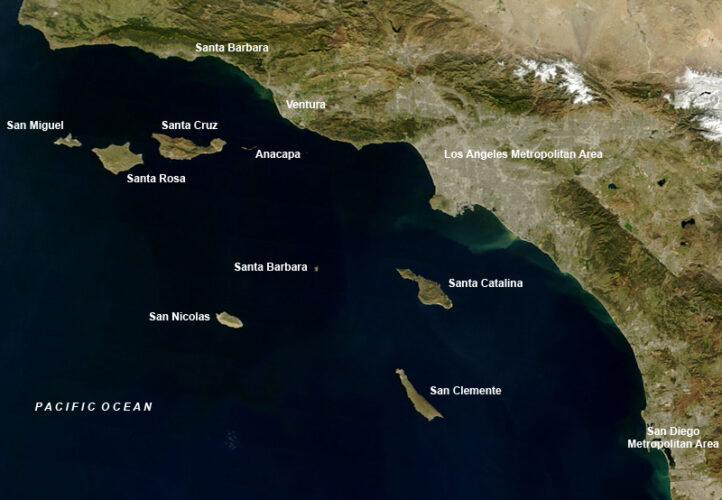
I joined experienced Channel Island explorers Bryant Burkhardt and Pedro Frigola in an ambitious plan to knock off all eight in one trip. When you look at the chart it looks very feasible. The 4 islands of the northern group; San Miguel, Santa Rosa, Santa Cruz and Anacapa along with the northern-most of the southern group, Santa Barbara make up the Channel Islands National Park. In addition to Santa Barbara Island, the islands in the southern group include Santa Catalina Island (commonly known just as Catalina), San Nicolas and San Clemente. San Nicholas and San Clemente are under the control of the U.S. Navy and the waters surrounding them are strictly controlled. They are used for live-fire practice and for Navy Seals to train so you most certainly don’t want to be in the wrong place at the wrong time! It is not lawful to land on either San Nicolas or San Clemente so we would have to paddle to and return from each of these islands without getting out of our kayaks, covering distances up to 80 nautical miles; which would take in excess of 20 hours. This is probably the main reason why no-one to our knowledge had attempted the challenge before.
We decided to attempt the challenge in early Fall as this period has the best potential for good weather, fewer foggy days than summer and hopefully less wind. We would also have less daylight so it would be necessary to paddle at night during some of the longer crossings.
We were a diverse group of paddlers with some considerable experience in long open ocean crossings:
Bryant Burkhardt was an avid kayaker. He headed the UCLA Sea Kayak Program and was the Valley Program Director for California Canoe & Kayak. In 2006 he captained the U.S. National Kayak Polo Team at the World Championships in Amsterdam, Netherlands. In 2010 Bryant produced his first paddling DVD entitled Paddle California and worked full time as an instructor and film-maker. Bryant had paddled to six of the eight Channel Islands, including a six day, 180 mile tour of the four northern islands (San Miguel, Santa Rosa, Santa Cruz and Anacapa) and a paddle out and back to Santa Barbara Island from the mainland. In 2009 he completed a 300 mile solo circumnavigation of Moresby Island in the Queen Charlottes, BC.
Pedro Frigola was an avid sea kayaker for nearly 20 years. He had paddled extensively in California’s Channel Islands, visiting all of the publicly accessible islands. His memorable trips in the area included a week long tour of the Northern Channel Islands (including crossing to and circumnavigation of San Miguel Island), and a weekend crossing to/from Santa Barbara Island and the mainland. Pedro had also enjoyed extended trips in the Pacific Northwest, where he had kayaked in the San Juan Islands, Canadian Gulf Islands, Desolation Sound, and Tofino. His other paddling destinations have included Canada’s Georgian Bay, Lake Powell, Yellowstone Lake, Florida’s southwest coast, French Polynesia, and the Ecuador’s Galapagos Islands. Originally from Cuba, Pedro spent most of his adult life in Southern California and enjoyed a variety of outdoor activities, photography, and occasionally even work.
On September 10th 2010 we set out from Gaviota on the mainland, west of Santa Barbara and headed south to San Miguel Island. This crossing had the most potential for wind and rough conditions. We timed it perfectly with barely a breath of wind to ruffle the glassy smooth surface of the ocean for almost the entire 26 nautical miles. Despite the beautiful weather, there was a slight chill to the air suggesting the fog wasn’t too far away. I wore my Gore-Tex Tec Tour Jacket for the last half of the crossing and was once again impressed how comfortable I was and wore the jacket for the next three days despite temperatures in the mid 60’s.
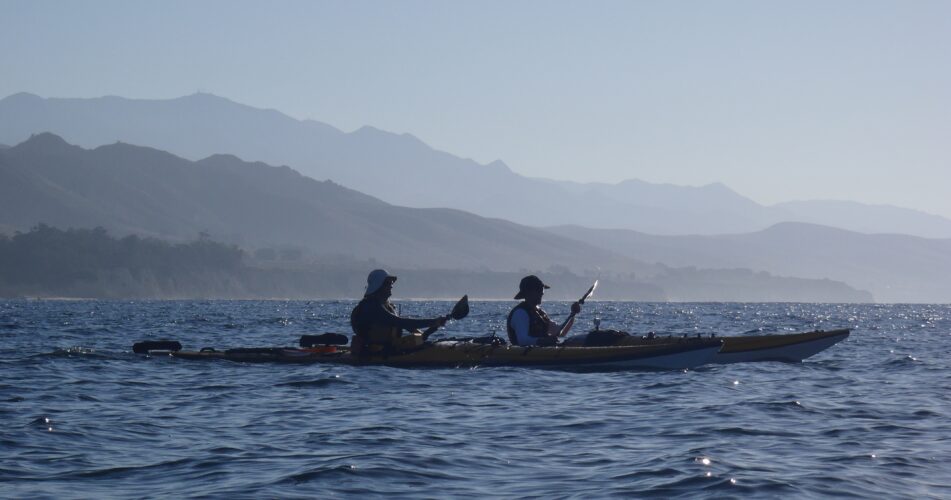 Leaving the mainland
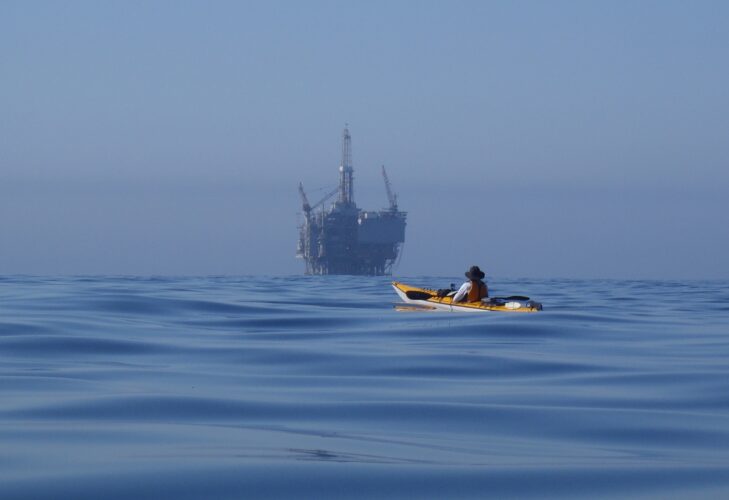 Oil rig mid-crossing
We arrived on a pristine beach on San Miguel and hiked up to the campsite, eating dinner watching the fog envelope the island as night fell. It was still foggy the next morning but almost no wind and barely any swell as we headed west around Point Bennett, the largest pinniped rookery on the west coast - over 30,000 (5 different species of seals, sea lions) sharing every available beach. A cacophony of barking and bellowing combined with a stench that was overwhelming, not helped by the huge rotting carcass of a dead blue whale. It was an incredible experience and set the tone for the rest of the journey around these amazing islands.
They say the Channel Islands are like mainland California was before Europeans arrived. We felt it was a privilege to paddle along this pristine coastline and we were lucky enough to experience almost perfect conditions. We made the short crossing to Santa Rosa Island before the wind got up and camped on another perfect beach on the south side of the island. A praying mantis seemed to want to share my abode but I didn’t fancy his alien-like eyes staring at me all night so we persuaded him to return to the undergrowth for which his camouflage was better suited.
Santa Rosa to Santa Cruz Island was yet another perfect day of coastal paddling with pods of dolphin in the Santa Cruz Passage and some hilarious sea lions off Gull Island.
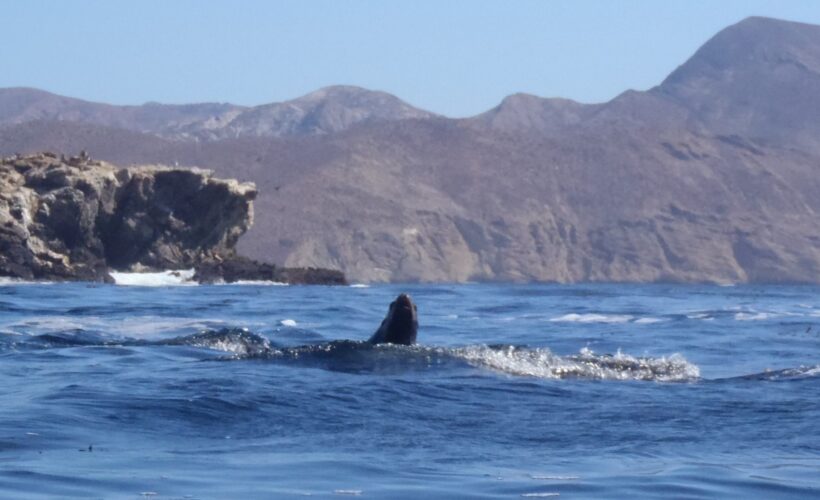 California Sea Lion
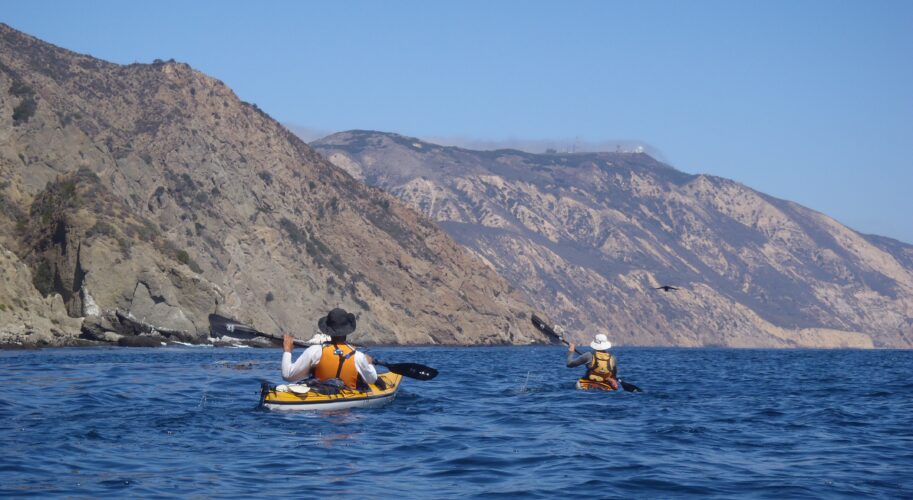 South coast of Santa Cruz Island
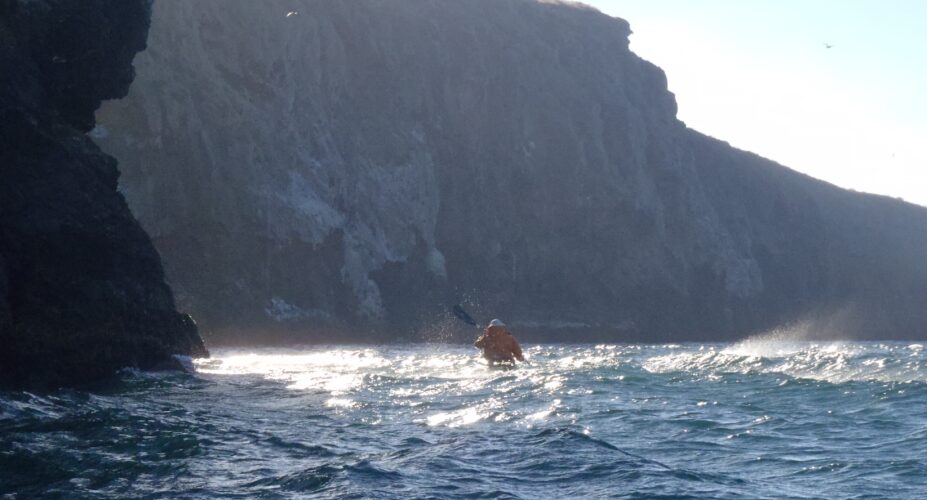 A stiff headwind as we approached Scorpion Anchorage
The day ended at the appropriately named Scorpion Anchorage, because after a long day in the kayak the sting in the tail was a nasty little 20 knot headwind that hit us as we came around the northeast side of Santa Cruz.
We decided to take a rest day the following day and contemplate our next moves. Pedro’s pace was unrelenting, but probably too slow to make the next long crossing to Santa Barbara Island an enjoyable experience for the group. Bryant and Pedro decided to return to the mainland via Anacapa allowing me to push on at my own pace.
I was using a P&H Cetus MV and I was very pleasantly surprised at how quick the boat was proving to be. I could keep up a steady cruise of four and a half knots and if I had help from any tail wind or following sea I could push that to well over five knots for hours at a time.
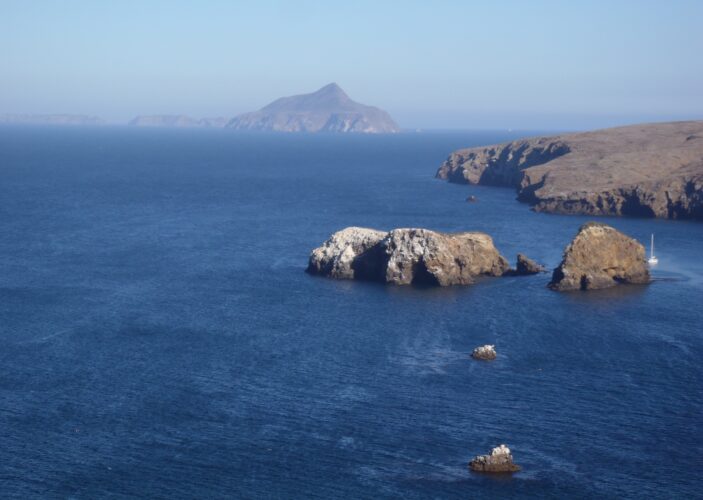 Anacapa from Santa Cruz Island
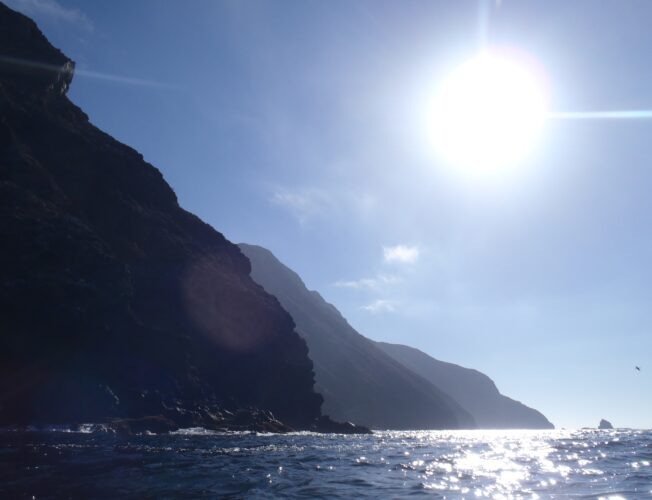 Anacapa up close - very few possible landings!
Anacapa is a chain of volcanic islands and I used the largest, West Island as a stepping stone before heading south to Santa Barbara Island, some thirty nautical miles away. It was a long, frankly largely boring crossing, the only excitement when a missile twice came screaming across the sky at low altitude, at a speed well in excess of any fighter jet I have ever seen. The whole area is part of a missile testing range and I had no desire to be a target. An annoying 20 knot cross wind developed towards the end of the day and I had to low brace numerous times as waves broke over my deck and I just hoped that the wind would relent for the paddle to San Nicholas the next day.
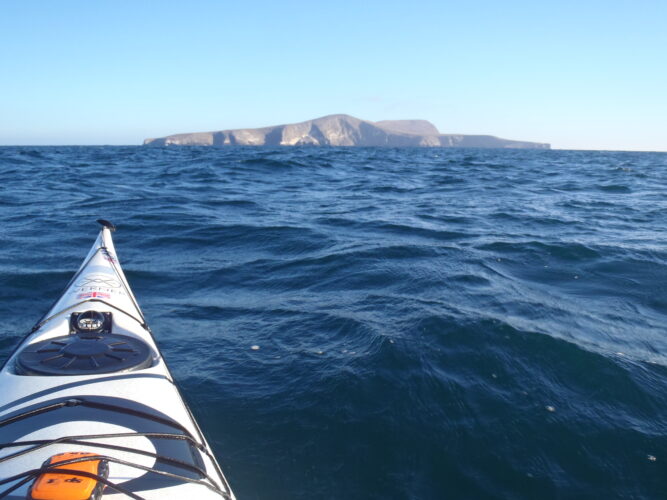 The long crossing to Santa Barbara Island
 The dock is the only legal place to land on Santa Barbara Island
Bryant and Pedro has warned me about the landing on Santa Barbara Island. The dock is the only legal place to land - the island has no beaches and any protected rock landings are covered in seals and sea lions. The dock was as brutal as I had feared. The surge from a southerly groundswell meant that using the ladder was impossible - I flipped my kayak trying to get out leaving a yard sale of charts and other paraphernalia floating in the cove. HUGE bull sea lions were swimming around me, unimpressed by my visit to their hareem, so I wasn't keen to go swimming!
I had to make the horrible decision to land my brand new, gorgeous P&H Cetus MV on the rocks, fully laden. I did my best to minimize the damage by jumping out of my kayak into waist deep water but believe me the volcanic rock on this island is the worst possible kind and I grimaced as I heard gel coat being scraped from the hull of my beautiful kayak as I heaved it beyond the grasp of the waves. Once ashore it took me two hours to carry my gear and the kayak up onto the dock where I saw a sign warning visitors to enter the water at their own risk as great whites had been witnessed attacking sea lions in the very same cove just a couple of months previously!
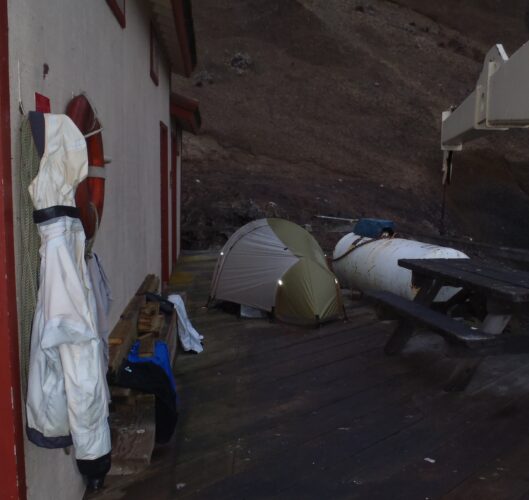 You are not allowed to camp on the dock! And BEWARE the mice!
It was dark and after an eleven hour crossing and such a brutal landing I was exhausted and didn’t bother with the steep climb to the campsite but instead pitched my tent on the dock and spent the rest of the evening fending off the deer mice that were as bold as can be and determined to steal my food. I wouldn’t have minded sharing but these guys are known to carry the Hantavirus which can be life threatening to humans. Great, I thought – even the mice are deadly!
The next morning I was pleased to see that the surge was less and the launch only took an hour and a bit more gel coat. I was already doubting my willingness to put my new boat through another landing on those rocks but if I was to visit San Nicholas Island, that would be exactly what I would have to do. Because you are not allowed to land on San Nicholas, I would have to make the 44 nautical mile round trip to San Nicholas and land once more on Santa Barbara Island. I set out for San Nicholas with grim determination to be the first to make it there by kayak but as I left the shelter of Santa Barbara Island I realized that the wind remained from the west. It had reduced to about fifteen knots, but it was going to be a very long and very hard paddle to San Nicholas. All sorts of questions and emotions ran through my head and after much debate I made the tough decision to abandon the attempt to reach all eight Channel Islands. To be honest, I just didn’t fancy it. I knew it was possible; I would just need to spend all day and probably all night paddling. I knew I didn’t want to do it and then face that same landing on the rocks.
So with the time pressure off, I spent an hour circumnavigating the small island of Santa Barbara, trying hard to not be disappointed with myself. The island had the most wildlife I have ever seen. The hillsides have been terraced by generations of elephant seals and sea lions. Guano from thousands of brown pelicans and cormorants have turned the dark volcanic rock as white was quartz. Caves were filled with the shiny black and brown bodies of sea lions. Blow holes exploded like geysers as the powerful swells, slowed by the thick kelp, forced their way into every nook and cranny. The corpses of dead Sea lion pups were picked at by gulls, their entrails nibbled by fish below. The sights, sounds and smells were as intense as my emotions - I knew that I was about to start heading home.
I began the 20 nautical mile crossing to Catalina with mixed feelings. I had turned my back on what would have been possibly one of the greatest challenges of my long padding career but I felt quite happy that I had made the right decision, both for me and my young family who would undoubtedly be pleased to see me much sooner than we had planned. It turned into a beautiful day the further east I paddled.
I was listening to my iPod to relieve the boredom of yet another long crossing when suddenly I felt, as much as heard, a big splash behind me. I assumed it was just another dolphin or sea lion but when I glanced over my shoulder I saw not just a dorsal fin but a tail fin as well. And it was going from side to side. A shark! And a big one! It must have come right out of the water for me to have felt its splash and now it was right behind me, bumping the stern of my kayak.
What should I do? My GPS told me I was 8.2 nautical miles from Catalina. There were no other vessels in sight. Great! I don’t mind admitting I was terrified. There must be something in a sea kayaker’s DNA that produces an overwhelming urge to paddle flat out when pursued by a shark. I resisted the urge to sprint, knowing that it would be futile and wanting to save my energy for a possible fight. The situation was quite bizarre. I distinctly remember Dire Straits’, “The Sultan of Swing” playing in my earphones as the shark chased me. The shark swam right underneath me, its dorsal fin close enough for me to hit with my paddle. As I did so it flicked the underside of my kayak with its tail, forcing me to low brace. I kept paddling and the shark circled and came right at me head on. I lunged at it again with my paddle but missed. As far as I am aware the shark never tried to bite the kayak or me for that matter but instead seemed intent on harassing me, like a cat with a mouse.
Again it was on my stern. I reverse paddled and the shark came by me, again flicking the boat with its tail as I hit its fin. I was using a wing paddle which is not great for low bracing but I was very determined not to capsize! The shark circled around and gave me the opportunity to get a really good look at it because the water was crystal clear. It was about ten to twelve foot in length, certainly not as long as my kayak. But it was just as sleek and really fast. I am fairly certain now it was a blue shark. It had a torpedo-like head and long slender tail and whilst I have only seen a small great white in an aquarium, this shark seemed more slender, more graceful. It was a beautiful fish and had I been in a decent sized boat, the encounter would have been wonderful. In these circumstances however, I felt completely vulnerable, truly scared and more than a little bit stupid. Why should I be surprised to see a shark? This was their domain. I was the intruder. I had probably paddled past dozens without knowing it but now I had met one that was either hungry or very curious.
The encounter lasted for about five minutes. What was really scary was how persistent the shark was. It must have known that I was not part of its normal diet. Yet it seemed intent on giving me a bad time. I had plenty of opportunity to take a picture of it as it cruised around me and chased my stern but I had absolutely no desire to take my hands off my paddle. I had a knife in my pocket but again was unwilling to let go of what I considered to be my best defense – a carbon wing paddle. I became exasperated. The thing just kept following me. What should I do? My VHF radio was in reach behind me but I felt a bit ridiculous shouting “Mayday” when the shark hadn’t actually bitten me.
In the end I summoned up the courage to take my hand off the paddle to reach into the pocket of my life jacket where I knew I had some energy bar wrappers. I threw these into the water in the hope of distracting the fish. Then I found a half eaten Power Bar that I had forgotten about. I threw that in as well. May be the shark went for it and realized that I didn’t taste good after all? Who knows, but finally after what seemed like a very long time, the shark disappeared.
 Post shark encounter
I took a picture of myself once I was confident the shark had gone. My wife Gina says she has never seen me looking so angry. I was, largely at myself for having put myself in such a ridiculous and dangerous situation. I have two young kids who need their Daddy. Of course I spent the next eight miles constantly looking over my shoulder but I never saw the shark again and to be honest, I hope I never see another shark like that, especially on my own and so far from land.
I landed on another beautiful beach on the east side of Catalina and finally got to talk to Gina on the phone after a week of no contact. I described the shark incident and she clearly wanted me to take the ferry back to the mainland from Catalina. But I have been surfing and kayaking California’s coastal waters for four years now and this was my first shark encounter. What were the chances of seeing another one the following day?
I could see the lights of the mainland that night and resolved to finish the expedition by kayak. And the following morning I had perfect conditions to make the sixteen mile crossing to San Pedro and Los Angeles.
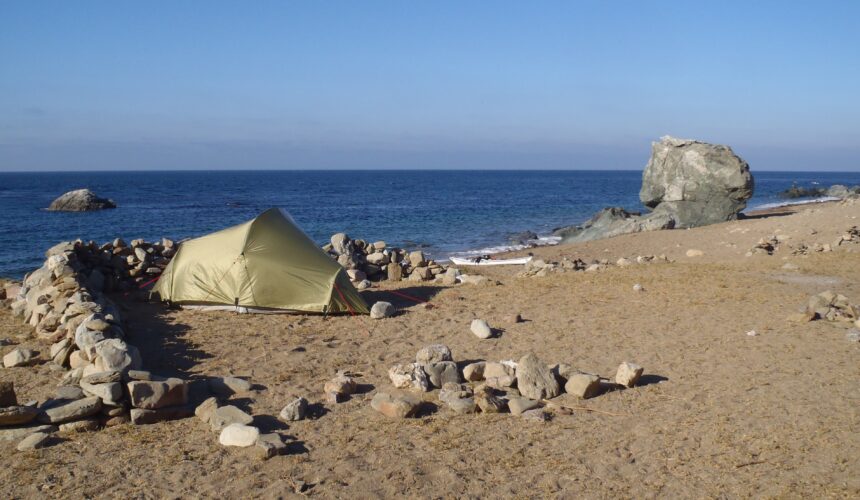 Campsite on the northeast side of Catalina Island
My wildlife experiences were not over. I had the exhilarating pleasure of paddling with perhaps as many as twenty blue whales that were just a couple of miles off the mainland coast. I thought of the millions of people going about their busy lives in L.A. who had never seen such a spectacle. It felt good to be alive!
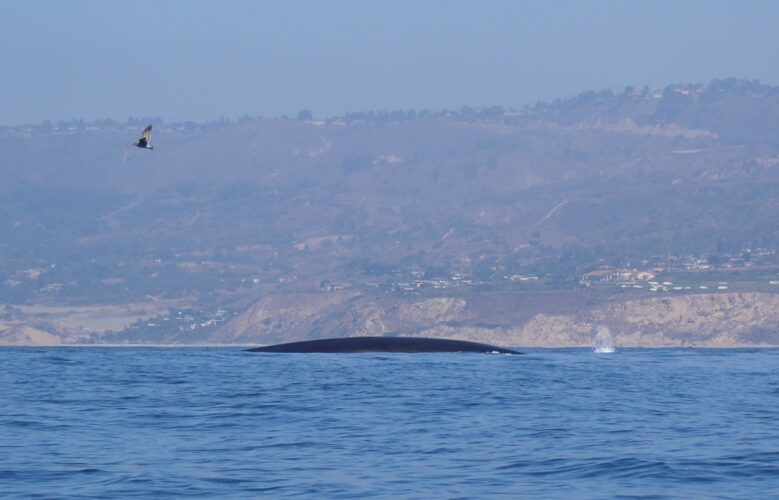 Blue whales just offshore
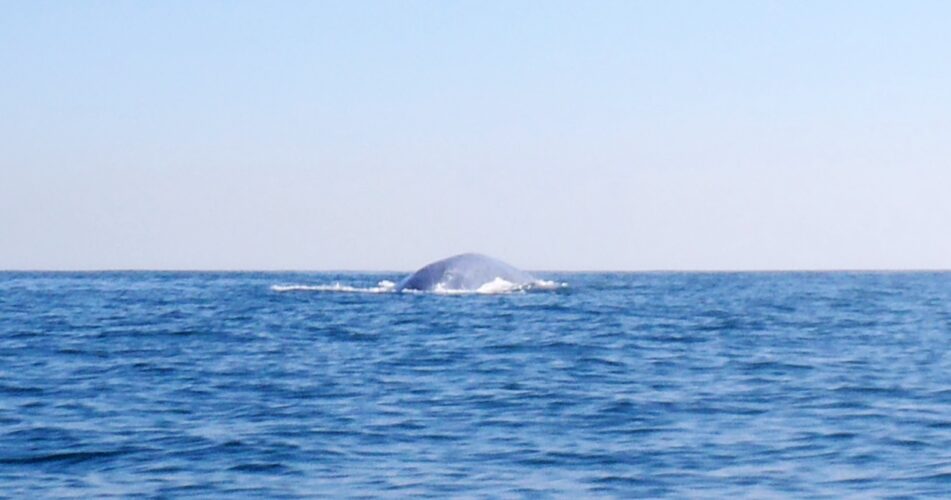 The size of a jumbo jet!
Pedro and Bryant had made it safely back to the mainland the day before and Pedro graciously gave me a ride back to my car. While the trip didn't go entirely to plan and the challenge to visit all 8 of the Channel islands remains undefeated, we remarked on what a spectacular coastline we have in California and just how lucky we are to live here.
This is Bryant's video of our journey: